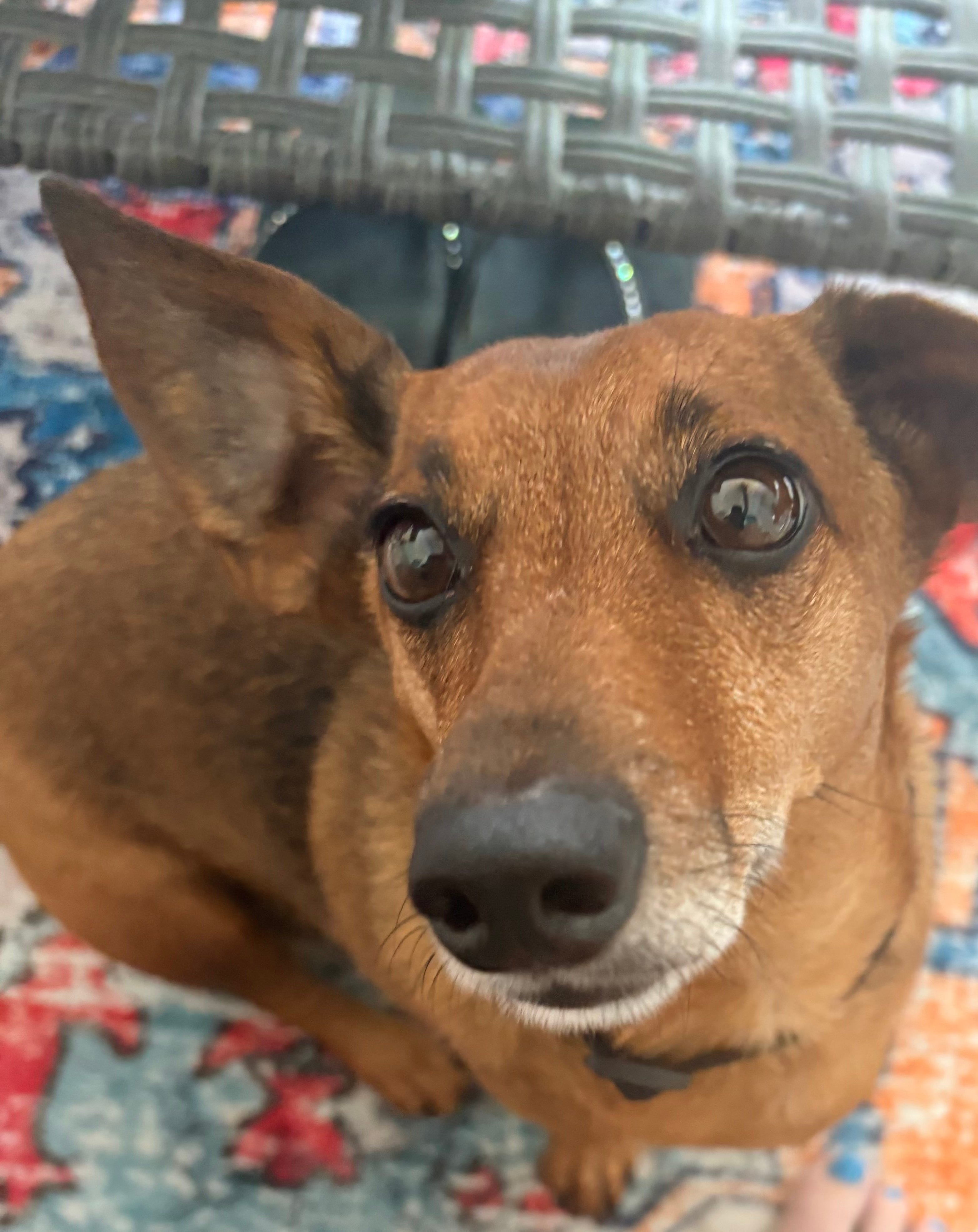
I have been thinking a lot about how quickly medications become the answer for dogs, especially gabapentin and trazodone. Not because these medications never have a place—they absolutely do—but because I watched how easily one badly handled appointment almost turned into a standing prescription for Harvey before every future veterinary visit.
Harvey had already spent a rough night at the emergency vet. He was exhausted, wired and doped up on seizure medications, which come with their own side effects and can leave him wobbly, disoriented and not quite himself. We stopped at our local vet for a blood draw, and a rookie technician had trouble with him. Harvey squirmed, yelped and wanted to get down. He did not bite. He did not snap. He was not aggressive in any way. He was a tiny, medically complicated senior dog who had been through hell the night before and did not appreciate being restrained and manhandled around his neck.
The technician became nervous, which made the handling worse, which made Harvey more upset. Rather than stepping back and asking whether there was a better way to do the blood draw, gabapentin and trazodone were prescribed for future appointments.
No. Not for us.
See your vet for a diagnosis and then you and I can collaborate on a custom strategy for your dog’s health.
I later worked with an experienced veterinarian who proved that Harvey’s veins were not “too tiny,” as I had been told. His blood could be drawn from his leg instead of his jugular. He did not need to be pinned down, and he did not need to be drugged into submission. What he needed was someone who knew how to handle a tiny senior dog, understood what he had already been through and was willing to adjust the procedure instead of blaming him for reacting.
This is exactly how dogs get labeled. They have one bad experience—sometimes because they are in pain, frightened, overmedicated, exhausted or handled poorly—and suddenly the chart says difficult, fractious or requires pre-visit medication. Then gabapentin and trazodone become part of every appointment for the rest of the dog’s life, even though nobody ever goes back and asks whether the original situation was handled badly.
That is the part that fires me up.
There are dogs who truly benefit from pre-visit medication. Some experience panic so severe that medication makes veterinary care safer and less traumatic. Some have a bite history. Some are in pain or need a procedure that simply cannot be completed safely without pharmaceutical support. I am not suggesting that pet parents refuse medication just to prove how natural they are. That is not fair to the dog, either.
But a dog who squirms, cries, pulls away or wants to get down is not automatically aggressive. A dog who is sedated is not automatically calm. A dog who can no longer physically resist may still be terrified.
Gabapentin is commonly prescribed for nerve pain, chronic pain, seizures, anxiety and sedation. Trazodone is frequently used for veterinary visits, travel, post-surgical confinement, fear and anxiety. Both can be useful. Both can also cause sedation, poor coordination, weakness, digestive upset, confusion, agitation or paradoxical excitement in some dogs. When they are used together, the dog may arrive at the veterinary office heavily sedated and physically unsteady before anyone has even assessed how he might respond with better handling.
In Harvey’s case, I would have preferred someone to ask a few basic questions first. What medications had he already received? How much sleep had he had? Was he in pain? Was he confused after the emergency visit? Did the blood really need to come from the jugular? Could someone more experienced try? Could I help hold him? Could we slow down for five minutes instead of escalating the restraint? Or — let’s try again another day.
Those questions require a little more time and thought than simply writing a prescription, but they also respect the dog in front of you.
And this problem is much bigger than gabapentin and trazodone. I see the same medication-first thinking in nearly every area of canine health.
The dog itches, so prednisone, Apoquel, Zenrelia or Cytopoint is prescribed, but nobody spends much time discussing food intolerance, yeast, bacterial infection, environmental chemicals, histamine burden or the health of the gut microbiome. The dog has diarrhea, so metronidazole is prescribed without enough conversation about parasites, stress, food changes, pancreatitis, dysbiosis or inflammatory bowel disease. The dog gulps, licks the air or vomits, so omeprazole or famotidine is added without asking whether the issue is meal timing, food intolerance, pancreatic disease, gallbladder dysfunction, kidney disease or medication side effects. A senior dog slows down or becomes restless at night, and gabapentin is prescribed without anyone discussing muscle loss, slippery floors, dental pain, spinal discomfort, rehabilitation or the cumulative effects of everything else the dog is already taking.
Any one of those medications may be appropriate. The problem is when the medication becomes the entire plan.
What I know is that controlling a symptom is not the same as understanding it. Sometimes we need to control the symptom quickly because the dog is suffering. An itchy dog should not be allowed to chew himself bloody while we conduct a philosophical debate about natural health. A dog in pain deserves pain relief. A bacterial infection may require antibiotics. A panicked dog may need pharmaceutical help to receive necessary care.
But after the immediate problem is under control, somebody still needs to ask why it happened and what can be changed.
That is where many pet parents are left hanging. They leave with a prescription but no real discussion about food, gut health, muscle condition, rehabilitation, stress, household exposures, sleep, pain patterns, lab trends or how the medication will eventually be reassessed. Months later, the symptom returns, the medication is increased or another drug is added, and now we are treating side effects from the treatment while the original driver is still sitting there waving at us.
I also do not believe holistic care means replacing one prescription with one supplement. Swapping gabapentin for CBD without understanding the source of the pain is still guessing. Replacing prednisone with a handful of herbs without understanding the immune pattern, infection risk or organ function is not automatically safer because the label has leaves on it.
The right natural support may include food changes, fresh food, omega-3s, herbs, CBD, medicinal mushrooms, microbiome restoration, physical rehabilitation, PEMF, cold laser, massage, bodywork, essential oils, Reiki or TCVM pattern support. But which of those belong in the plan depends on the individual dog: age, diagnosis, medications, kidney and liver function, diet history, stool patterns, weight, muscle loss, pain, stress, seizures, labwork and everything else already being given.
This is why I have become much stricter about casual recommendations. People sometimes want a quick answer—what can I give for itching, pain, diarrhea or anxiety? I understand why. They want to help their dog today. But medically complicated dogs are rarely simple, even when the question sounds simple, and I do not want to throw another product into the mix just because it was the first modality that came to mind.
Veterinary medicine is essential. Harvey needed emergency care that night. He needed seizure control, diagnostics and monitoring. I am grateful those tools exist. I am not anti-vet, and I am not anti-medication.
I am anti-lazy answer.
I am against a prescription replacing investigation. I am against blaming the dog when better handling could have changed the experience. I am against stacking two more sedating medications onto a senior dog already struggling with seizure drugs because one inexperienced technician panicked when he squirmed.
It is a reminder to be your dog’s best advocate.
You are allowed to ask respectful questions. You are allowed to ask why a medication is being recommended, continued or refilled You’re allowed to ask what the risks are, whether other approaches have been considered and whether your dog’s behavior could have been influenced by pain, fear, exhaustion, existing medications or poor handling.
You are allowed to say, “I am not comfortable with that.”
You are allowed to request a more experienced technician, ask for a different blood-draw location, remain with your dog, request less restraint or stop a procedure when it is clearly escalating.
And you are allowed to find another veterinarian or veterinary team when you no longer feel heard.
That does not make you difficult. It makes you responsible for the animal who cannot explain what happened after everyone leaves the room.
Harvey did not need gabapentin and trazodone because one blood draw went badly. He needed someone who knew how to draw blood from a tiny dog on new meds after a night of seizures without turning it into a wrestling match. An experienced veterinarian later proved that, and Harvey handled it just fine.
Sometimes medication is the right answer. Sometimes the dog needs pain relief, anxiety support or sedation so necessary care can happen safely.
Hopefully, it’s temporary while you explore other options for the future routine events.
More from The Well Oiled K9
For the comprehensive version covering commonly prescribed medications, their uses, possible concerns and whole-dog support options, visit:
Commonly OverPrescribed Medications For Dogs
https://welloiledk9.com/danas-take/commonly-overprescribed-medications-for-dogs-when-the-prescription-becomes-the-whole-plan
Gabapentin for Dogs: Side Effects, Concerns and Natural Alternatives
https://welloiledk9.com/health/gabapentin-pain-management-dogs
The Well Oiled K9 Membership
https://welloiledk9.com/membership
This article reflects my personal experience and professional opinion. It is intended for education and wellness support and is not a substitute for veterinary diagnosis, treatment or emergency care. Do not stop or change prescription medication without working with your veterinarian.