

I was sitting at a pet-friendly restaurant recently when something on the dog menu made me pause.
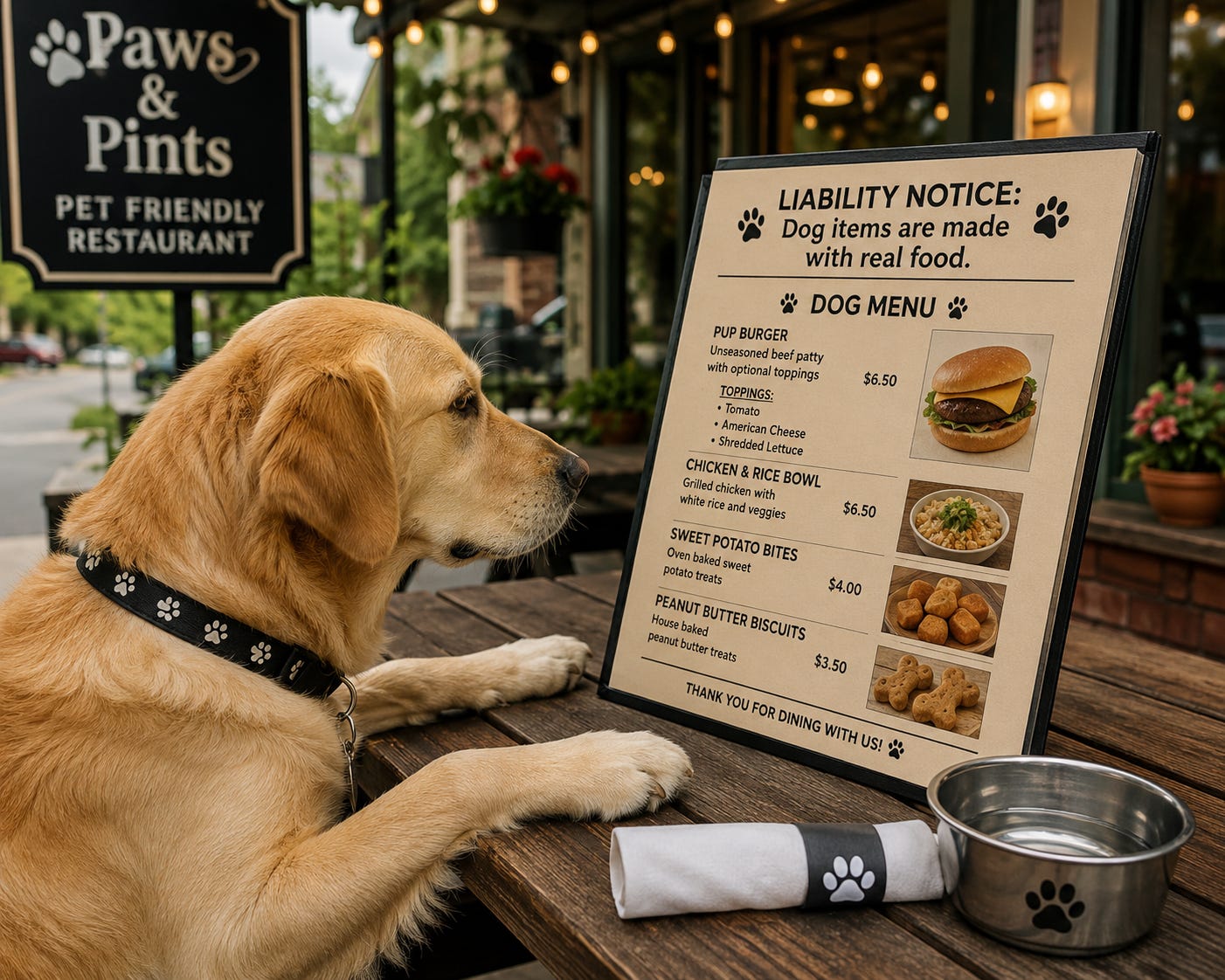
Not the actual menu :-)
But funny what Chatgpt came up with — I mean isn’t chicken, rice, peas and carrots a balanced me?
(insert sarcasm — and why you can’t trust chatgpt fully)
At the top of the pet-friendly menu section was a liability notice:
“Dog items are made with real food.”
I sat there for a second because… wow. That one little sentence said a whole lot about where we still are with dogs, food, and fear.
Not artificial preservatives. Not ultra-processed ingredients. Not synthetic flavor enhancers. Not rendered meals, rancid fats, chemical additives, or “natural flavor” mystery dust.
Real food.
I understand listing ingredients. I understand saying “contains dairy” or “gluten-free” or “ask about allergens.”
But a liability notice because the dog treats are made with real food? Aka People food as many like to call it.
So I snapped a photo and shared it because I thought the point was obvious. I assumed people would see the same irony I saw.
Boy was I wrong.
The comments immediately turned into:
“That causes pancreatitis.”
“Dogs shouldn’t eat people food.”
“Tomatoes are toxic.” (they are safe is small amounts — aka the snack burger)
“American cheese is horrible.”
“This is why dogs get sick.”
And I just sat there thinking…
Did everyone miss the point, or are we really this far off track?
Because the entire reason I shared the local photo was the absurdity that a business now feels the need to legally protect itself for serving real food to dogs.
My point was about the fear of people food and the fact that so many dogs cannot actually eat a treat like this.
I wasn’t even thinking about the menu item itself — a snack burger with lettuce, tomato and cheese.
And yes, before someone gasps into their kibble scoop, nobody is claiming this treat is a balanced meal or superfood.
But a tiny bite of American cheese on an occasional snack burger is not the hill canine nutrition needs to die on.
The burger itself was unseasoned. No onions. No greasy fast-food mystery meat situation. I’ve had preferred it to be raw and no bun — but that would be a whole new liability on handling raw meat at a restaurant.
It was an unseasoned burger offered on a pet-friendly menu.
And somehow, in people’s minds, real food became the danger.
That reaction told me more about modern pet nutrition culture than the menu ever did.
We’ve Been Conditioned to Fear Real Food
Somewhere along the way, we lost the plot.
Dogs evolved alongside humans eating real food: meat, organs, scraps, fish, eggs, connective tissue, seasonal foods, and leftovers.
Long before kibble existed.
And yet now many pet parents have been so conditioned by modern pet food marketing that fresh food itself creates panic.
A fresh burger patty? Dangerous.
But heavily processed pellets that can sit on a shelf for months or years somehow feel “safe” because they came from a bag with scientific wording and a veterinary recommendation attached to it.
That disconnect is fascinating. And honestly, it’s a little terrifying.
We are now so disconnected from actual nutrition that a restaurant feels compelled to issue a liability warning because dog treats are “made with real food.”
Read that again.
Made with real food.
As though real food alone should concern us.
“But Pancreatitis!”
This came up over and over in the comments.
And let me be very clear: pancreatitis is serious. I’m not minimizing that for one second. It can be painful, dangerous, expensive, and in some cases life-threatening.
But “people food” as a whole is not the real issue.
Real food is not automatically the problem.
The bigger issue is that many dogs now have fragile digestive systems from years of ultra-processed food, diets void of natural enzymes, inflammatory ingredients, poor gut diversity, unstable microbiomes, chronic stress, medications, obesity, repeated chemical exposure, and metabolic dysfunction. And people are scared of real food.
And yes, we also need to talk about the role of rendered or rancid fats, poor-quality non-animal fats, high-carbohydrate diets, and aging digestive systems that may not be producing enough enzymes to handle food well anymore.
That is very different from saying, “real food, causes pancreatitis.” — especially fresh, raw or gently cooked food.
Sometimes one small bite of unfamiliar food becomes the thing that exposes the imbalance, and suddenly the hamburger gets blamed for the whole collapse.
That does not mean every dog should eat rich foods freely. Some dogs need lower-fat meals. Some dogs need slower transitions. Some dogs with a history of pancreatitis need much tighter management. Some dogs need digestive enzymes, gut repair, and microbiome support before they can handle variety well.
That is individualized nutrition.
But we need to stop pretending fresh food itself is the villain.
The bigger question is this: why are so many dogs’ digestive systems so unstable that a small amount of real food can tip them over?
The Part That Honestly Surprised Me
What surprised me most wasn’t disagreement.
At this point, disagreement is expected. I work in holistic pet health. I promote fresh food. I push back on outdated nutrition ideas. I question the “just feed the bag forever” approach all the time.
So no, I am not shocked when people disagree.
What surprised me was how quickly people interpreted “real food” as the problem.
Not kibble.
Not ultra-processing.
Not the fact that so many dogs have digestive systems so unstable that one bite of actual food can cause chaos.
Real food.
That matters.
Because if the majority of pet parents still resist someone like me promoting real food, and if they push back even on real food as an occasional snack for kibble-fed dogs, then we have more work to do.
If people panic over a tiny bite of tomato…
If a little piece of American cheese on an occasional snack burger causes outrage…
If people genuinely believe fresh meat is more dangerous than years of ultra-processed feeding…
Then we have a serious education gap.
Not because people are stupid.
Because the conditioning runs deep.
Most pet parents truly believe they are protecting their dogs by avoiding “people food.” They’ve been taught that real food is risky while processed food is normal.
That belief system did not appear overnight.
It was built over decades.
And moments like this remind me exactly why education matters.
Dogs Are Still Biological Animals
Dogs are not fragile little processed-food machines.
They are biological animals.
Their bodies recognize moisture. Their bodies recognize protein. Their bodies recognize fresh nutrients. Their digestive systems benefit from variety, quality, and less processing when introduced appropriately.
And ironically, many pet parents who start adding fresh foods the right way notice real improvements:
better stools
healthier weight
improved energy
better muscle tone
healthier skin
fewer digestive issues
more excitement around meals
improved mobility
Not because fresh food is magic.
Because real food is biologically normal.
Now, does that mean every dog should be handed a greasy restaurant meal every weekend? No. Don’t be ridiculous.
But a healthy dog having an occasional unseasoned real-food snack at a pet-friendly restaurant is not the downfall of canine health.
The bigger issue is that so many people no longer recognize real food as normal.
The Real Liability
The more I thought about that menu, the more I realized the liability notice accidentally exposed something much bigger.
The real liability is not the unseasoned burger.
The real liability is that we’ve become so disconnected from food that “made with real food” now sounds dangerous.
The real liability is that pet parents are being taught to fear fresh food while trusting ultra-processed diets without question.
The real liability is that dogs’ guts are often so unstable from years of poor-quality food and chronic stress that a small bite of real food can become a serious problem.
The real liability is longevity.
And instead of asking why the gut is so fragile, people blame the cheese.
This is why I keep talking about fresh food, gut health, enzymes, microbiome support, low-tox living, and individualized nutrition.
Because if a dog’s body cannot tolerate a small amount of real food, that is not proof real food is bad.
That is a sign we need to ask better questions.
And yes, we clearly still have a lot of work to do.
If you have a dog you’re afraid to give “real food” to — we should talk and work on their gut.
Want more discussions on fresh feeding, natural wellness, behavior, longevity, low-tox living, and helping dogs thrive naturally?
Visit:
The Well Oiled K9
Join the community and member discussions:
WelloiledK9 Substack
Schedule a consultation:
Dana Brigman Consultations
Statements in this blog have not been evaluated by the FDA. Educational content only. Not intended to diagnose, treat, cure, or prevent any disease.
Join us in the chat to discuss!
