

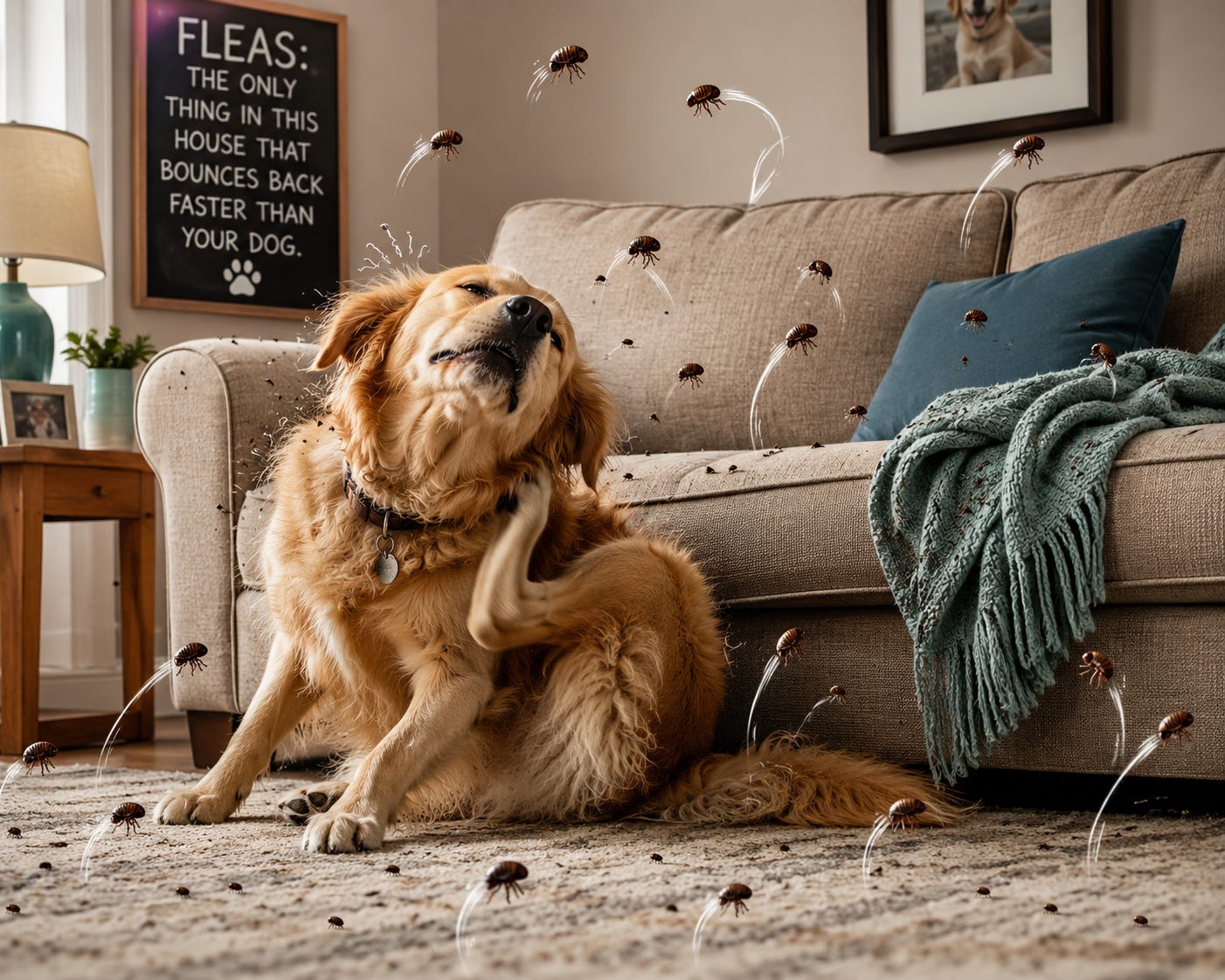
Welcome to summer. It seems like everyone is panicking this week. I’m on my eleventy-billionth inquiry about fleas and ticks. Full on infestations - new puppies, traveling adventures, in the house, we just moved to the south, and so on.
Every year, I say the same thing:
Start early.
Use layers of prevention
Support the dog — from the inside out and topically.
Remember a healthy body is a terrible host. That means good nutrition, healthy skin, non-attractive odor, etc.
Treat the yard. Way more important than you realize — but a big challenge for apartment dwellers.
Do not wait until you have an infestation.
And every year, plenty of people wait until they have an infestation.
So here we are.
Let’s talk about fleas, ticks, traditional products, natural options, puppies, active infestations, yard treatment, and the long-term prevention strategy most people want to skip until they are in a pickle.
And don’t forget — when you’re a member with me — you’re getting seasonal reminders before it’s time!
The Problem With Waiting Until There Is A Problem
Fleas do not show up politely one at a time and announce themselves.
By the time you are seeing fleas on your dog, there may already be eggs, larvae, and pupae in the house, bedding, rugs, furniture, yard, and anywhere else your dog spends time.
The goal is not to throw every chemical product at your dog and hope for the best. The goal is to build a smart, layered plan that reduces exposure, supports the dog’s body, and keeps you from reaching the “I need something nuclear” stage.
The Products That Concern Me Most
There are products I personally avoid whenever possible.
Hartz Flea and Tick Products
If there is one product line that consistently worries me, it is Hartz.
Over the years, there have been many reports of reactions ranging from skin irritation to neurologic symptoms and, in some cases, death.
Could some dogs use them without issue?
Sure.
Some people also eat gas station sushi and live to tell the story. That does not make it my recommendation.
There are too many better options available for me to suggest gambling with these products.
Seresto Collars
This one always starts arguments.
Many pet parents swear by Seresto collars. I understand that. They are convenient, they last a long time, and people like easy.
But convenience is not the same thing as low-risk.
Seresto collars have been associated with many adverse event reports over the years, including neurologic symptoms, seizures, skin reactions, behavior changes, and deaths. Even though it’s not “ingested”, I assure you those toxins are still making their way into your dog’s bloodstream through fur and skin.
Does every dog react?
No.
But if you have a dog with seizures, allergies, autoimmune disease, cancer, liver disease, kidney disease, unexplained behavior changes, or medication sensitivity, I would think very carefully before adding constant chemical exposure around the neck 24/7.
Isoxazoline Products
This category includes products such as:
NexGard
Simparica
Bravecto
Credelio
The FDA has acknowledged neurologic adverse events associated with this class of medications, including seizures, tremors, and ataxia.
Many dogs take these products without obvious side effects. But I believe these dogs are indeed accumulating toxins in their systems.
This is especially important if your dog has a seizure history, unexplained anxiety, neurologic symptoms, chronic health issues, or high sensitivity to medications.
Every pet parent deserves informed consent before making that decision.
Not fear.
Not shame.
Not “just do what everyone else does.”
Informed consent.
I explain these product risks on my website.
What I Prefer Instead
My goal is not to kill every bug within a three-mile radius. But wouldn’t that be cool.
My goal is to make your dog a less attractive target while reducing unnecessary chemical exposure.
Think layers of protection.
Not one magic product.
No single spray, pill, collar, tag, oil, herb, vitamin, or prayer candle is going to carry the whole plan.
Essential Oils
This is one of my favorite tools.
Many insects rely heavily on scent to locate hosts. Certain essential oils help create an environment that is less appealing to fleas, ticks, mosquitoes, and other pests.
Commonly used oils include:
Lemongrass
Cedarwood
Geranium
Citronella
Lavender
Peppermint
Eucalyptus
Kunzea
I use essential oils as part of a larger strategy, not as the only strategy.
The goal is deterrence, not poisoning the dog.
This can include outdoor sprays, collar applications, bandanas, yard sprays, and environmental support.
And yes, quality and proper use matter.
Kin + Kind, 4-Legger, and Ready-Made Options
I love my essential oils. Understatement.
I love Animal Scents products.
I love hydrosols and customized natural wellness tools.
But let’s be honest: sometimes people need something today, and not everyone is ready to mix their own products.
That is where ready-made options come in.
Kin + Kind and 4-Legger products are good examples of natural options that are easy for pet parents to use. Many can be ordered quickly, including from Amazon, and often delivered fast.
If your dog is itchy today, you do not need to spend three weeks “researching” while the fleas build a vacation home in your carpet.
Get something appropriate.
Use it.
Then build a better plan.
If your dog hates the sprays and spritzes, turn it into homemade wipes. Easy peasy!
Garlic
Cue the internet panic.
When used appropriately, fresh garlic has been used for generations to help make dogs less appealing to fleas, ticks, and mosquitoes.
No, I am not talking about feeding an entire bulb of garlic.
No, garlic is not automatically toxic just because someone made a dramatic meme about it.
I am talking about appropriate amounts based on body weight, the individual dog, and common sense.
Fresh garlic is one of the tools I use as part of a broader prevention strategy. It is not the whole plan, but it can be a useful piece.
Vitamin B Support
Some dogs seem to be bug magnets.
Vitamin B support is often used as part of a natural insect-deterrent plan. It is not a standalone solution, but it may help support the overall strategy.
Again, layers.
Always layers.
Ultrasonic Flea and Tick Tags
Ultrasonic tags sound like the perfect low-tox solution: no sprays, no pills, no pesticide collars.
But results are mixed.
Some pet parents swear by them. Others see no difference at all. I consider them a possible extra layer, not a complete prevention plan.
One thing to keep in mind is that dogs hear frequencies we do not. Some sensitive dogs may not tolerate constant ultrasonic input well.
If you notice new anxiety, restlessness, collar avoidance, sleep changes, or increased sensitivity after adding one, remove it and reassess.
Helpful for some dogs?
Maybe.
A miracle shield?
Nope.
What About Puppies Under 6 Months?
This is where I become much more conservative.
Puppies under six months are still developing. Their nervous system, detoxification pathways, gut microbiome, and immune system are immature.
This is not the age where I want people grabbing the strongest product on the shelf because they forgot summer happens every single year.
For puppies, I prefer focusing on:
Environmental control
Daily tick checks
Flea combing
Yard management
Gentle natural repellents
Clean nutrition
Gut support
Immune support
Careful observation
Puppies are not tiny adult dogs.
If you are using essential oils — dilution is very important.
Read labels carefully. Many products have age and weight restrictions. Natural does not mean “use anything, anytime, on anyone.”
Be thoughtful.
What If Your Dog Already Has Fleas?
You can have the best prevention plan in the world and still end up with fleas.
It happens.
But if you are already seeing fleas, now is not the time to dab one drop of lavender on a bandana and call it a day.
You need to act.
The goal now is simple:
Kill the active fleas.
Treat the environment.
Soothe the skin.
Prevent the next generation.
Step One: Reduce The Active Fleas
For active fleas, I often suggest getting the immediate problem under control first and then switching to prevention.
Options include:
A single Dawn dish soap bath (assuming you have no other options on hand!)
Flea combing
Washing bedding
Vacuuming daily
Borax
Treating the home environment
A single Dawn bath can dramatically reduce the number of active fleas.
I do not recommend using Dawn as a routine shampoo. It is a one-time “we have an urgent problem” tool.
Use it, rinse well, and move on. Follow with an epsom salt rinse.
Step Two: Consider Capstar For Big Infestations
For severe infestations, Capstar can be extremely helpful.
Capstar works quickly and can dramatically reduce the active flea burden while you address the environment.
If you have dozens of fleas jumping on the dog, the couch, and your ankles, this is not the time to argue online about holistic versus conventional approaches.
Get the infestation under control first.
Then build a better prevention plan moving forward.
If you only treat the dog and ignore the house and yard, you are fighting a battle you are going to lose.
Follow with an epsom salt rinse and some milk thistle.
Step Three: Soothe The Skin
Once the active fleas are under control, do not forget the skin.
Many dogs continue scratching for days or even weeks after the fleas are gone because the skin remains irritated and inflamed from the bites.
Helpful recovery options may include:
Epsom salt soaks for irritated paws and feet
Cooled chamomile tea rinses or sprays
Cooled green tea rinses or sprays
Aloe vera gel
Colloidal oatmeal baths
Lavender hydrosol
Roman Chamomile hydrosol
Helichrysum hydrosol
Animal Scents Ointment
CBD topical products such as Soothe
Gentle bathing with a quality natural shampoo
Do not allow your dog to drink Epsom salt soak water.
Do not use soaks or sprays on open wounds, raw skin, or severe irritation.
The sooner you support the skin, the sooner everyone in the house gets some sleep.
If the itching continues long after the fleas are gone, it may be time to look deeper at allergies, gut health, detoxification pathways, inflammation, and immune balance rather than assuming fleas are still the problem.
The flea may not be the entire problem.
Sometimes the flea simply exposes an underlying imbalance that was already there.
The Yard Matters More Than Most People Realize
Many people focus entirely on the dog.
The yard is often the real problem.
If you keep putting a clean dog back into a flea-filled yard, congratulations, you have created a flea subscription service.
Cancel it.
Beneficial Nematodes
Beneficial nematodes are microscopic organisms that help reduce flea populations naturally.
I love them because they work with nature rather than against it.
They are especially useful in shaded, moist areas where fleas like to develop.
Diatomaceous Earth
Food-grade diatomaceous earth can be useful in certain dry areas.
The key word is dry.
Once wet, effectiveness drops dramatically.
Avoid creating dust clouds around pets or people. You do not want anyone breathing that in.
Wondercide and Cedarcide
Wondercide and Cedarcide are popular options for yards, patios, and outdoor living areas.
Many pet parents have success incorporating them into a broader flea and tick plan.
Keep the grass trimmed. Reduce debris. Pay attention to shady resting areas. Treat the places your dog actually spends time.
If you’re in a condo or apartment the yard can be a problem — so finding a good solution for your dog is important.
The Long-Term Prevention Strategy Nobody Wants To Talk About
My goal is not just flea prevention.
My goal is building a dog that is less attractive to fleas, less reactive to flea bites, and more resilient when exposed to the inevitable bugs, pollen, mold, heat, humidity, and environmental stressors of summer.
This is one of the reasons I spend so much time talking about fresh food, gut health, detoxification, immune balance, and overall wellness.
People often ask why I am talking about nutrition when they asked about fleas.
Because everything is connected.
The dog eating fresh food, receiving quality nutrition, maintaining a healthy microbiome, supporting detoxification pathways, and avoiding unnecessary inflammation often responds very differently than the dog living on ultra-processed food with chronic skin issues and underlying immune dysfunction.
That is why we talk about fresh food.
That is why we talk about fresh garlic.
That is why we talk about low-tox living.
That is why we talk about seasonal support.
That is why we talk about the terrain of the dog, not just the bug on the dog. Healthy bodies make terrible hosts! And your dog’s scent (or oils we use) can make your dog less attractive.
There is no magic spray, collar, pill, essential oil, supplement, or herb that replaces building a healthier dog from the inside out.
If you have spent any time on my website, you have probably noticed that nearly every road eventually leads back to the same foundations:
Fresh food
Gut health
Reduced inflammation
Detoxification support
Immune balance
Low-tox living
That is not an accident.
Those foundations affect allergies, skin health, digestion, behavior, longevity, and yes, even how your dog responds to fleas and ticks.
So if you are new here and wondering why I keep talking about nutrition in a flea article...
Go read the website.
No, seriously.
Go read.
I have written about this over and over because it matters.
Then come back and join the discussion.
Use the Community chat here in substack.
Ask questions. I absolutely will talk with you about it.
Share what is working.
Tell us what is not.
Learn from other pet parents.
Because chances are, if you are wondering about something, someone else is too.
My Summer Flea And Tick Strategy
If I were starting from scratch, my approach would look something like this:
Feed fresh, species-appropriate food.
Support gut health and immune function.
Use fresh garlic appropriately.
Add Vitamin B support when appropriate.
Use essential oil deterrents.
Use Kin + Kind, 4-Legger, or another quality natural product when needed.
Consider ultrasonic tags only as an optional extra layer.
Check for ticks daily.
Flea comb regularly during high-risk seasons.
Wash bedding often.
Vacuum frequently if fleas are suspected.
Treat the yard with beneficial nematodes.
Use Wondercide or Cedarcide in outdoor areas.
Keep grass trimmed.
Address fleas immediately instead of waiting for an infestation.
Most importantly, stop letting social media convince you there are only two choices:
Chemical everything.
Or do nothing.
There is a large middle ground where many pet parents successfully reduce exposure, support their dog’s health, and manage fleas and ticks naturally.
But you do have to actually do the things.
Reading the article does not repel fleas.
Saving the post does not treat the yard.
Thinking about ordering a spray does not soothe the dog.
Take action before you are in a pickle.
Your dog will thank you.
Your ankles will thank you.
Your vacuum cleaner may still be annoyed, but we cannot please everyone.
Need More Help?
If you are dealing with fleas, ticks, Lyme concerns, heartworm prevention questions, or you are trying to figure out the safest approach for a puppy, senior dog, seizure dog, allergy dog, or cancer dog, you will find additional articles, guides, and discussions throughout the website and Substack community.
Visit: https://welloiledk9.com
Schedule a consultation: https://danabrigman.as.me
Products I recommend are on my affiliate page: https://welloiledk9.com/affiliate-links
Use the Community chat for questions, discussion, and shared learning.
This is exactly what the community is for.
Statements in this article have not been evaluated by the FDA. Educational content only. Not intended to diagnose, treat, cure, or prevent any disease.
“Common oils you use” list
Do you have suggedtions for carrier oil. My dog has allergic to mct & sweet almond oil as my carrier oil. Will coconut oil work? Or any suggestions.
Wondercide flea & tick yard spray is wonderful for your lawn And it makes your yard smells so good.